
Most organizations want a smoother, more proactive safety program—but the idea of adding new technology can feel overwhelming. The good news? Safety software implementation doesn’t have to disrupt your workflows or slow down your teams. When done right, it actually accelerates everything: hazard identification, JHA creation, crew communication, and leadership visibility.
SafetyVue was built to enhance the workflows safety teams already use. Instead of forcing new processes onto your crews, it seamlessly plugs into daily routines—making safety faster, more objective, and easier for every user. This implementation guide walks you through exactly how to roll out the platform, from introducing the Mobile App to crews to training safety professionals on SafetyVue AR.
At every step, the goal is simple: give your team the intelligence to prevent.
Why SafetyVue Is Easy to Implement: The Platform at a Glance
Before starting any safety software implementation, it’s important to understand what you’re adding—and why it works.
SafetyVue connects field data, asset histories, personnel records, and hazard insights into one predictive ecosystem known as the Data Flywheel.
- Capture – SafetyVue AR scans a jobsite in under five minutes to produce a first-draft JHA.
- Enrich – Information flows into your unified platform, where it’s automatically linked to assets, people, and historical data.
- Generate Intelligence – AI uncovers patterns and leading indicators that help prevent incidents before they happen.
Most organizations begin implementation by rolling out two primary tools:
- SafetyVue Mobile App – For daily field reporting, quick documentation, and fast, consistent communication.
- SafetyVue AR – For safety professionals performing walkdowns, investigations, and risk assessments with objective data.
Phase 1: Preparing for a Smooth Safety Software Implementation
A successful safety software implementation starts with clarity—not technology.
1. Identify what’s slowing your current process
Common gaps include:
- Handwritten or inconsistent JHAs
- Slow site walkthroughs
- Delayed hazard reporting
- No unified visibility for leadership
2. Map exactly where SafetyVue fits into your existing workflows
SafetyVue should enhance what you already do, such as:
- Daily pre-task planning
- Routine inspections
- Near-miss and incident investigations
- Leadership safety reviews
3. Set success metrics before rollout
Examples include:
- JHA creation time reduced by 70%
- Higher hazard identification frequency
- Consistent AR scans across sites
- Better compliance visibility for leadership
SafetyVue’s mission-driven voice reinforces that implementation is not about adding new tasks—it’s about removing friction and empowering every role.
Phase 2: Rolling Out the SafetyVue Mobile App to Field Crews
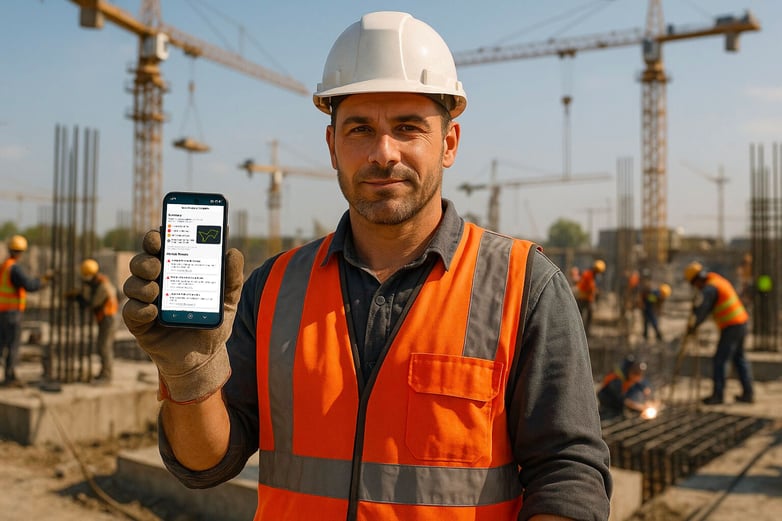
Rolling out the Mobile App is typically the first milestone in a safety software implementation.
Keep onboarding fast and practical
Most crews learn best through demonstration, not documentation. A 10-minute walkthrough is enough to show:
- How to capture notes
- How to attach photos
- How to submit observations in real time
How to drive adoption from day one
- Start with a pilot group or trusted foreman
- Encourage crews to replace paper processes immediately
- Show the time savings—this matters more than anything
- Reinforce that SafetyVue supports their expertise, not replaces it
SafetyVue explicitly respects the expertise of safety professionals and field teams. The platform removes tedious admin work so humans can focus on what matters.
Integrate Mobile App use into existing routines
- Morning pre-task meeting → open app → document hazards
- Throughout the day → add observations, photos, notes
- End of shift → finalize documentation
This ensures SafetyVue becomes a natural part of your safety culture.
Phase 3: Rolling Out SafetyVue AR to Safety Professionals
SafetyVue AR is the biggest value driver in your safety software implementation, especially for organizations wanting to move beyond reactive reporting.
What SafetyVue AR changes
- 5-minute JHA draft creation using automated hazard identification
- Objective site scans that eliminate subjectivity
- A defensible, verifiable record of what the jobsite actually looked like
SafetyVue AR generates a detailed first-draft JHA in under five minutes—something no competitor offers.
Train safety professionals hands-on
- Perform 2–3 AR scans during the first session
- Compare automated results to traditional walkdowns
- Show how AR frees time for deeper risk analysis
Position AR correctly to avoid cultural resistance
SafetyVue AR is not replacing human judgment—it enhances it. It creates consistency and removes the administrative burden so safety professionals can think strategically.
Phase 4: Connecting the Data—Where SafetyVue Unlocks Its Full Value

Once Mobile App and SafetyVue AR adoption is underway, the payoff of your safety software implementation becomes clear.
Unified data transforms visibility
Every scan, report, and observation feeds into the Data Flywheel:
- Asset histories grow richer
- Personnel training needs become clearer
- Incident trends become predictable
- Hazards become preventable instead of reactive
Leadership gains something they’ve never had before: intelligence, not just documentation.
Phase 5: Training Your Workforce Through SafetyVue’s LMS
If your SafetyVue deployment includes training, integration with SafetyVue's LMS strengthens your implementation with:
- CEU-backed training paths
- Custom content for internal policies
- Clear assignment, tracking, and compliance workflows
The LMS supports mobile learning, skill paths, and ongoing career development—ideal for reinforcing the behaviors surfaced by SafetyVue’s field intelligence.
Common Implementation Pitfalls (and How SafetyVue Avoids Them)
1. Overcomplicating the rollout
SafetyVue’s phased structure prevents overload.
2. Field resistance
Workers adopt it quickly because it removes admin burden.
3. Disconnected data
SafetyVue’s platform automatically unifies asset, personnel, and incident information.
4. Lack of leadership visibility
Dashboards make proactive risk control possible for the first time.
These pitfalls derail most safety software implementation efforts—SafetyVue is designed specifically to avoid them.
A Sample 30-Day Implementation Plan
Week 1: App rollout to pilot crew + SafetyVue AR training
Week 2: Expand to two more crews + begin routine AR scanning
Week 3: Leadership dashboard review
Week 4: Full rollout + connect training workflows
Implementation Is Not a Hurdle—It’s the Start of Proactive Safety
Safety software implementation should make safety easier, faster, and more predictive. That’s what SafetyVue delivers. By integrating smoothly into your existing processes—from daily crew workflows to high-level safety strategy—you create a connected ecosystem that continually makes your organization safer.
Download the Field Intelligence Playbook

Learn how industry leaders operationalize proactive safety using real-time data and AR-powered insights.